性福五月天

Phishing and Scams

Phishing is a form of social engineering delivered by email. Phishing scams appear to originate from a trusted source to trick you into entering your credentials, revealing personal identifying information (PII), or sending money to them.

The attacker can then use this information to access your accounts, gather additional private information about you in an attempt to steal your identity, and make purchases or apply for credit in your name.

You can learn more about phishing and social engineering by reading the information here.


Phishing Tips

  • Move your mouse over links in emails and it may show a different URL than the one displayed.
  • If you are encouraged to click a link that claims to lead to a legitimate site (such as Amazon), look online for a trusted URL leading to that site instead.
  • Check the sender address to verify that the email comes from an official source.
  • Check for slight mispellings - in the URL, company name, etc. For example, paypa1.com instead of paypal.com.
  • Use additional software - Many browsers have add-ons/extensions/plug-ins that can help detect phishing sites.
  • Be wary of anything that gives a sense of urgency, or states that it requires immediate action.
  • Don't click anywhere in suspicious emails鈥攅ven in what may appear to be white space.
  • Be wary of too-good-to-be-true offers such as free airline tickets or vacation.
  • Don鈥檛 open attachments in unexpected or suspicious emails or instant messages.
  • Don鈥檛 send passwords, bank account numbers, or other private information in an email.

Note that 性福五月天 will NEVER ask for your password through email.

For more advice on how to avoid phishing scams, visit our Fight the Phish page!

Have I Been The Victim Of A Phishing Scam?

If you believe that you have been the victim of a phishing scam, change your password immediately and report it to phish@kent.edu or submit a support ticket. Also, don't forget to check out our account security article for tips on how to keep your accounts safe. If you are using Gmail, you can also end all other active sessions. This should stop any unauthorized access to your account. Instructions on can be found here. You can also by following the instructions here.

When a victim of a phishing scam, it's common practice for the hackers to change your signatures, forwards, filters, and other settings. If you believe you fell victim to a scam, we recommend checking the following settings in your mail client.

  • A signature for an email is text that is automatically inserted at the end of an email. It is usually something you choose to set up. Make sure it is not an unfamiliar one setup.
  • Forwards can be set up to automatically forward to another email address. Make sure it is not forwarded to unknown address without your permission.
  • Inbox rules/filters can be used to automatically sort or delete anything in your inbox or sent box etc.  Scammers can use it to re-direct/hide their messages.
  • Check all of the folders in your email account - sometimes the malicious actor may create new folder to store messages they sent/receive or put them into the Trash when using your account to perform scams.

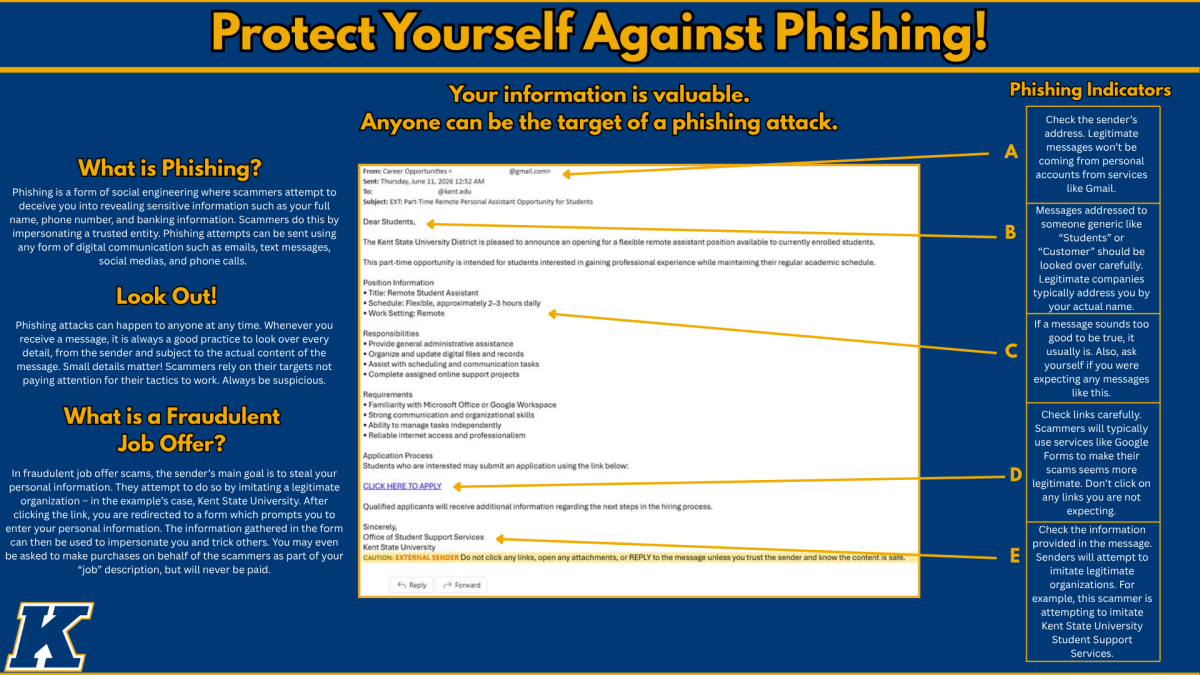
(Click to enlarge)
Don't Get Hooked Poster

What Are Scams?

Scams come in many forms and are a type of social engineering to either gain your personal identifiable information (PII), or steal your money. They are getting more and more sophisticated, particularly when it comes to targeting you online and through mobile devices. It鈥檚 important to know how to recognize a scam so you can protect yourself from fraudsters.

Note that KSU will NEVER ask for your password through e-mail, so be wary of anything that says otherwise.

Please report any scams you receive to phish@kent.edu. You can learn about additional ways to report phishing scams here: Report Phishing

How To Detect a Scam?

  • Scammers pretend to be from organizations you know
  • They pretend that you won a prize or that there is a problem
  • Scam calls will usually pressure you to act immediately
  • If it sounds too good to be true, then it probably is
  • Scammers will tell you to pay in a specific way

Steps To Avoid Scams

  • Don鈥檛 give out any personal information
  • Resist pressure
  • Block unwanted calls or messages
  • Don't click on any pictures, links, or white spaces in a suspicious email
  • Stop and talk to someone before taking action or giving out any information

Please refer to the site to read more about common scams and how to report them.


Tax season is right around the corner!

With the rapid arrival of the tax season also arrives a wave of scammers hoping to get their hands on your money and personal information. Tax season is a very common time for identity theft and finance scams, so be careful! Scammers approach the season in several different ways, so it鈥檚 important to be aware of who is behind the tax information you are receiving! 
 
Keep in mind as well that if it seems too good to be true then it probably is. Below, we have created a list of some common tax season scams to look out for! Remember, if you see something, say something. Report suspicious messages to our team at phish@kent.edu if you believe you have received a phishing message. Our team members will analyze the message, determine if it is legitimate or malicious, and send you a reply that contains the results of our investigation and additional guidance.
 
For more general information on phishing in general, please see our phishing and scams page! To learn more about tax-season scams, you can visit the official IRS page featuring for this tax season. 

Tax Season Scams

As you prepare for tax season, we recommend reading about some of the most common techniques that scammers will use to try and steal your sensitive information. Learning about these techniques will help you keep yourself 鈥 and others 鈥 safe from fraudsters!

Bad Social Media Advice or Advertising

Not all advice is good advice. Social media influencers are always trying to build their platform and gain a larger following. What's a better way to do that than speaking on new topics to reach a new audience? Tax season is a great opportunity for influencers to share their experience with doing their taxes and give advice to help others. Unfortunately, sometimes that advice tells followers to lie on their tax forms to get more money in return. Some people on social media may post videos claiming to have gotten a large sum of money through this tax preparer versus going to a more well-known company that will 鈥渞ip you off鈥.  These influencers do this in an attempt to steal your personal information and your tax refund.  Also, listening to their advice about lying on these government documents will get you into legal trouble.  

False Tax Preparers

In some cases, scammers will pose as tax preparers to steal your money. In this scam, these false tax preparers are more likely to target individuals who either do not have a solid understanding of the U.S. tax system those who do not speak English as their first language.

Some of the tell-tale signs of this type of scam include fees based on refund sizes, the tax preparer being fully unwilling to sign your return for proper identification, and inflating deductions with fake benefits and credits. When filing your taxes, be careful who you choose for help. There are those out there that just want to make quick cash and see your taxes as an opportunity to do so.

To avoid this scam, it is best to ask for references from your tax preparer before signing anything, ask people you trust for tax preparer recommendations instead of picking someone random, or utilize the provided by the IRS to find a legitimate tax preparer near you. 

Free or Unclaimed Money

During tax season, scammers also like to make offers promising or alerting you of money you may be missing out on. These scams can either relate to the promising of free money upon completion or unclaimed tax refunds.  
 
In scams that promise free money, scammers often target specific smaller communities or church groups. When it comes to these scams, the individual making these offers often will help file these taxes incorrectly for more exaggerated returns to steal the refund from their victims. If someone is offering to help you with taxes and pay you money, remember that no one should ever pay you to file your taxes! This is a common way for theft to occur. 
 
On the other hand, unclaimed tax refund scams tend to come through notices that you have a new and unclaimed refund from filing your taxes that you are not expecting. These messages can come through email, text messages, and in some cases may even come by physical letter. They contain the scammer鈥檚 contact details for you to reach out and claim the refund that is waiting for you. However, upon doing so the scammer will request sensitive information from you either for their own financial gain or to commit identity theft. 
 
If you are filing your taxes and you receive an offer for free money or a notice regarding unclaimed tax refunds, it most likely is not real. Always check if this information is coming from official IRS contacts. If it is not coming from legitimate contacts, then the message is a scam!  

Fake Charities

Unfortunately, another common scam found prominently in tax season pertains to fake charities. These fake charities pop up in times of disaster or a crisis of some sort and take advantage of not only the kindness but also, in some cases, the vulnerability of certain individuals. 
 
In these scams, the perpetrator will approach their potential victim with a phone call or email soliciting financial support to help assist natural disaster victims or support those fighting disease. During the interaction, they tell the taxpayers they are targeting that they can make tax-free donations and may be able to claim deductions in the hope of enticing them to send not only their money, but also their personal information.  
 
These scammers tend to target individuals in an area that has recently been victim to a natural disaster or specific individuals who have recently lost loved ones to a particular illness. These people tend to be targets because the scammers know that they may be the ones most willing to support their fake cause.

Luckily, if you receive an email requesting a donation and personal information and you are unsure of the charity, the IRS provides where you can check the legitimacy of the donation. It is always better to be safe than sorry! If you are unsure of a message, do not provide any information and do your research this tax season.

Fake IRS Contact

The IRS primarily contacts you through the USPS mail service. After their initial contact with you via mail, they also may contact you in these ways:

  • Email: the IRS will never initiate contact with you via email, and will not contact you via email at all unless a criminal investigation is being carried out. More information about contacting the IRS via email when working with them on such a case can be found on the .

  • Text message: the IRS will never send unsolicited text messages that demand immediate action or payment. The IRS will only text you after 1) initiating contact with you via another method (most often through mail) and 2) you give them permission to send you text messages.

  • Phone: phone calls regarding threats of criminal charges are not from actual IRS agents. Do not give any information to the caller. The IRS may contact taxpayers through a phone call to resolve matters relating to an account, but will not ask for payments over the phone.

  • Fax: the IRS may send fax messages to verify or request employment information. If the authenticity of a fax that claims to be from the IRS is in question, before responding to the fax.

  • Social media: the IRS will never use social media to contact you or request payment. While the IRS does have social media accounts, they will never use them to send a direct message to a taxpayer.

  • In-person visits are rare; the IRS typically sends a letter before a visit. IRS employees always carry IRS issued credentials or (Homeland Security Presidential Directive 12) cards for in-person visits.

If you come into contact with someone who claims to be an IRS agent, and you suspect them to be fraudulent, ask for their name, title, and phone number, but do not call them back or contact them again. Any incident like this should be reported to the police. Additionally, you can with questions or concerns if you receive any correspondence that seems unusual or malicious.
 
If you think you have provided information to a fake IRS agent, we recommend that you follow the steps on
 

Types of Phishing and Scams

Scammers will use many different methods to try and trick you into giving them important information. Click one of the topics below to learn more about phishing techniques, common scams, and additional advice to help keep yourself safe!

  • Scammers will employ various techniques during their phishing campaigns. These are designed to make their attacks more effective, and are often changed depending on the target. Click one of the topics below to learn how to identify and protect yourself from these techniques!

  • There are many different types of online scams that are designed to steal your money, identity, credentials, and other sensitive information. Though some of these scams seem very different from the others, most scams share several common red flags. Click one of the topics below to learn more about how these scams work, and how to protect yourself and others from them!

  • When it comes to phishing, scams, and online security, there's a lot to learn. Knowledge is the best defense against cyberattacks. Click any of the articles below to learn more about a topic of interest!